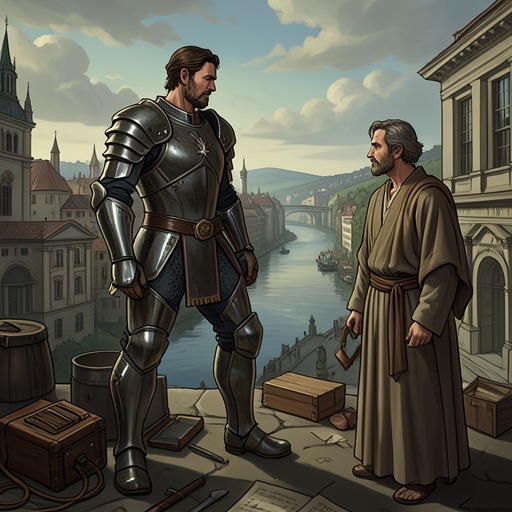
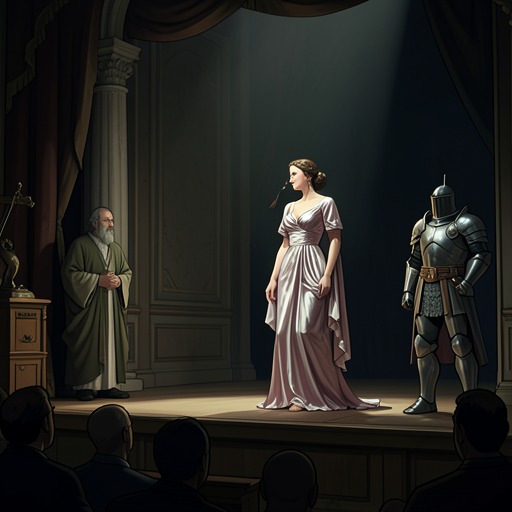
Assassination of Dong Zhuo
The Romance of the Three KingdomsThe Assassination of Dong Zhuo is a calculated palace coup in which Wang Yun and his allies use a forged imperial decree to bring Dong Zhuo within reach of an armed group, and Lü Bu turns against the man who had become his adoptive father. The plot removes the central figure of Dong Zhuo’s tyrannical rule, but its aftermath makes clear that killing a ruler is not the same as restoring order: reprisals and political distrust continue even after the court celebrates his death.
Background and the conspiracy
Dong Zhuo’s authority had grown out of the Han court’s collapse. The novel presents him as a powerful usurper whose conduct made him hated by the people and, in Lü Bu’s account, a burden to them. Lü Bu had once been persuaded by Li Su to kill his former benefactor, Ding Yuan, and join Dong Zhuo. Now that earlier betrayal becomes part of the case against Dong Zhuo: Lü Bu tells Li Su that the deception which brought him into Dong Zhuo’s service helped enable Dong Zhuo’s increasing ambition and wrongdoing.
Wang Yun and two friends settle on a plan to summon Dong Zhuo to the palace on the pretext of a meeting with the emperor. The intended outcome is explicit: Dong Zhuo is to be killed as soon as he enters the palace gate. To make that possible, the conspirators need someone to deliver a false imperial decree ordering him to return from Meiwu. They choose Li Su, whose history with Lü Bu gives the mission a personal dimension as well as a political one.
Lü Bu welcomes the chance to take revenge for Ding Yuan and to humiliate Li Su, whom he threatens with death if the mission fails. Yet he also frames the reversal in public terms, claiming that Dong Zhuo’s actions have made him hateful to both people and gods. Li Su agrees that he wants Dong Zhuo dead and carries the forged decree to Meiwu the next day. The conspiracy thus binds together revenge, political opposition, and the practical use of deception.
The forged summons and the palace killing
Li Su presents the summons as an opportunity for Dong Zhuo to accept the throne. He tells him that the emperor, recovered from illness, wishes to discuss abdicating in Dong Zhuo’s favour. The message is false, but it fits Dong Zhuo’s ambition. He treats the apparent offer as auspicious and prepares to set out; even his mother’s warning that she has a bad feeling does not dissuade him.
At the palace entrance, Dong Zhuo finds officials assembled in ceremonial dress. Li Su walks beside his sedan chair with a drawn sword, outwardly appearing to protect him. Wang Yun and his supporters are waiting near the Reception Hall, and Dong Zhuo notices that they are armed. He asks what is happening but receives no answer from Li Su. Wang Yun then identifies him as a traitor and calls for the executioners.
Armed men emerge and attack. Dong Zhuo has not put on his breastplate. As he calls for his son, Lü Bu appears and answers that he has come with a decree to kill the traitor. Lü Bu strikes Dong Zhuo with his halberd; Li Su then takes Dong Zhuo’s head and displays it. Lü Bu produces the supposed decree and declares that it orders Dong Zhuo’s death, not the punishment of anyone else. The document that brought Dong Zhuo to court is therefore also presented as the authority for the killing, turning a forged summons into a staged claim of lawful execution.
The assembled officials and courtiers respond with relief and acclaim the emperor. Their celebration gives the coup an appearance of collective approval, but the sequence rests on an ambush rather than a public judgement. The scene’s political reversal is sharply concentrated in Lü Bu: the man Dong Zhuo treated as a son now stands beside his attackers and uses the language of a decree to announce his death.
Reprisals at court and Meiwu
Dong Zhuo’s death releases accumulated anger. Li Ru is also executed, while Dong Zhuo’s head is displayed in the marketplace and passers-by abuse it. These reprisals extend the consequences beyond the palace and show that the killing becomes an occasion for public vengeance as well as a transfer of power.
Lü Bu then leads an armed group to Meiwu. There he frees Diao Chan and orders the slaughter of Dong Zhuo’s family, including his elderly mother. Soldiers also find young women from noble families held there as captives and release them. The group seizes Dong Zhuo’s large collection of treasures. The campaign is thus presented as both a purge of the former ruler’s household and the recovery of people and property taken under his rule; at the same time, the killing of his family makes the scale of the retaliation unmistakable.
The celebrations that follow do not settle the political situation. When Wang Yun hears that someone has mourned Dong Zhuo, he orders the suspected mourner found. The man proves to be Cai Yong, a senior official writing the history of the Han dynasty. Cai explains that Dong Zhuo had once treated him kindly and that he considers mourning for him an obligation, despite recognizing his crimes against the Han. He pleads to be allowed to live so he can continue writing the history.
Wang Yun refuses. He fears that Cai Yong might record false accounts about the Han, and orders him killed despite pleas for clemency. The episode complicates the victory claimed by the conspirators: the man who helped remove a tyrant now suppresses a historian whose loyalty to the dynasty includes acknowledging a personal debt to Dong Zhuo. The coup has ended Dong Zhuo’s rule, but its leading survivor acts in ways that make political loyalty and historical memory newly precarious.
Political meaning and narrative function
Dong Zhuo’s assassination belongs to a broader account of Han disintegration in which rival leaders carve kingdoms from the ruins of central authority. The novel’s political history does not treat the killing as a self-contained rescue of the dynasty. Dong Zhuo’s removal is a decisive reversal, but it leaves armed factions, contested authority, and unsettled relations behind. His death changes who commands the court without resolving the crisis that made his rule possible.
The event also establishes a recurring tension between political legitimacy and the means used to claim it. The conspirators invoke the emperor and frame the killing through a decree, but the summons itself is forged and the decision to kill Dong Zhuo has already been made. Later struggles over rule likewise draw on competing claims about the Han, the mandate of Heaven, and the right to govern. In this episode, the formal language of imperial authority lends a public shape to an act of conspiracy rather than demonstrating that the court has regained effective control.
The book’s wider design combines historical events with dramatic retelling, folk performance, and the novelist’s shaping of the material. The assassination is presented through deliberate staging: the misleading invitation, the ceremonial gathering, the armed welcome, Lü Bu’s reversal, and the public display of the outcome. That sequence makes the fall of Dong Zhuo legible as a turning point in the story of dynastic collapse while refusing a simple ending. The tyrant is dead; the violence and political instability outlive him.